
Grassroots grants
Grassroots gants
Grassroots grants
September 30, 2025
Save the Children's SHIFT: how stablecoins can accelerate localisation
Save the Children's SHIFT: how stablecoins can accelerate localisation
How Save the Children's SHIFT initiative and the Shift Power Organisation ran a milestone-based grant pilot in Malawi, kept the compliance load proportionate to the grant size, and preserved more than 80% of the funding's local value against currency devaluation.
How Save the Children's SHIFT initiative and the Shift Power Organisation ran a milestone-based grant pilot in Malawi, kept the compliance load proportionate to the grant size, and preserved more than 80% of the funding's local value against currency devaluation.
Our partners
Save the Children's SHIFT initiative and the Shift Power Organisation are reshaping how grassroots youth groups get funded.

%
%
Funding value preserved
Funding value preserved
Against Malawian kwacha devaluation
Against Malawian kwacha devaluation
%
Partner satisfaction
Partner satisfaction
SPO and Save the Children Malawi
SPO and Save the Children Malawi

$
Disbursed
Two milestone-based payments to a youth-led climate group.
+
People reached
160 students trained directly, 4,000+ peer-cascaded.
Custodians trained
SPO leadership onboarded for wallet management.
Save the Children had been working with the Shift Power Organisation for three years. A youth-led climate group in Lilongwe, using drones to map waste streams, partnering with the Mayor's office, running environmental education across primary schools. The relationship was real. The funding pipeline was the problem.
When Save the Children's SHIFT team ran the feasibility study, they hit the wall every localisation effort hits. The institutional infrastructure was built for grants up to $80,000. The same vetting tools, the same procurement standards, the same due diligence. Apply that to a $1,000 youth-led microgrant and the system rejects itself. Not because the partner isn't credible. Because the cost of proving credibility, in staff hours and process load, is bigger than the grant.
That's the actual barrier between donor money and grassroots impact. It's not policy. It's plumbing.
What we built with SHIFT
Save the Children's SHIFT, the Shift Power Organisation, and Coala Pay ran a milestone-based pilot designed around the constraints of a small grassroots group, not in spite of them.
The Shift Power Organisation opened a digital wallet with hands-on support. Two custodians were trained, both named in a Letter of Authorization. Because Save the Children already had three years of working history with the group, the streamlined Coala Pay due diligence cleared the partnership in days of active processing, gated by a turnaround on identity documents that would have taken 24 hours under cleaner inputs.
The Shift Power Organisation submitted a project proposal through the Coala Pay marketplace. The proposal was coded into a smart contract with two milestones built in. $1,000 on submission of the campaign plan and budget. $1,000 on delivery of results, photos, and videos.
Save the Children funded the contract from headquarters. Coala Pay converted to USDC and held the funds in escrow against the milestones. When Save the Children's Malawi office signed off on each delivery, the smart contract released the tranche directly to the group's wallet. From there, the Shift Power Organisation off-ramped to Malawian kwacha through Yellow Card and into local bank accounts.
Every step left an audit trail on-chain. Save the Children received a unique algorithmic-art proof-of-payment token per disbursement, which feeds directly into reporting dashboards and shows programme spend by partner, location, and type without anyone keying anything.
What changed because of it
$2,000 reached a youth-led group that, under the conventional pipeline, would have struggled to receive any direct funding at all.
The full grant value was preserved against the kwacha's ongoing devaluation. Holding the funds in stablecoin between disbursement and off-ramp meant the group received roughly 3,700 kwacha per dollar, against a local currency that has been losing value against the dollar at a fast clip. Anything sitting in a bank during that window would have lost a meaningful share of its purchasing power.
Transaction costs were small. Average gas fee of $0.70. A 0.5% conversion fee. 500 kwacha per off-ramp. The grant arrived close to fully intact.
160 students were trained directly across four primary schools. More than 4,000 reached through peer cascade. Children produced charcoal briquettes, liquid fertilizer, compost, and biogas using community waste, and co-wrote waste-management manuals tailored to their own neighborhoods.
Save the Children's Malawi team and the Shift Power Organisation both rated the platform 5 out of 5 on ease of use. 100% said they'd use stablecoins again. Transparency was rated "Excellent."
Why this matters more than the dollar amount suggests
A $2,000 pilot is small. The point isn't the size. The point is that the same mechanism scales sideways across every grassroots group the localisation agenda has been trying to reach for a decade.
When the compliance load is right-sized to the grant size, when the settlement layer doesn't bleed value to foreign exchange and intermediaries, and when the audit trail is generated automatically rather than reconstructed manually, direct funding to community-led groups stops being an aspiration and becomes an operating model.
The development sector has been talking about localisation since the 2016 Grand Bargain. The pledge was 25% of humanitarian funding to local actors. The actual figure is still in single digits. The bottleneck has never been intent. It's the absence of infrastructure that lets large institutions transfer small amounts of money to small organisations without making the cost of the transfer larger than the transfer itself. That's what this pilot demonstrates is now solvable.
Where this goes next
Save the Children's SHIFT initiative can extend the same model to other youth groups, other country offices, other small-grant types. Coala Pay's continuous compliance screening means partners stay onboarded across multiple grants, so the marginal cost of the second, third, and tenth disbursement keeps falling.
Two known limitations are already being worked. Yellow Card's daily off-ramp cap meant the Shift Power Organisation's disbursements were split across multiple bank deposits over several days. Higher tiers and weekday-only scheduling close that gap.
And SHIFT, the Shift Power Organisation, and Coala Pay are co-developing a multimedia onboarding toolkit, including videos, infographics, and translated guides, so the next youth group can self-serve more of the wallet setup with less hands-on support.
SSave the Children had been working with the Shift Power Organisation for three years. A youth-led climate group in Lilongwe, using drones to map waste streams, partnering with the Mayor's office, running environmental education across primary schools. The relationship was real. The funding pipeline was the problem.
When Save the Children's SHIFT team ran the feasibility study, they hit the wall every localisation effort hits. The institutional infrastructure was built for grants up to $80,000. The same vetting tools, the same procurement standards, the same due diligence. Apply that to a $1,000 youth-led microgrant and the system rejects itself. Not because the partner isn't credible. Because the cost of proving credibility, in staff hours and process load, is bigger than the grant.
That's the actual barrier between donor money and grassroots impact. It's not policy. It's plumbing.
What we built with SHIFT
Save the Children's SHIFT, the Shift Power Organisation, and Coala Pay ran a milestone-based pilot designed around the constraints of a small grassroots group, not in spite of them.
The Shift Power Organisation opened a digital wallet with hands-on support. Two custodians were trained, both named in a Letter of Authorization. Because Save the Children already had three years of working history with the group, the streamlined Coala Pay due diligence cleared the partnership in days of active processing, gated by a turnaround on identity documents that would have taken 24 hours under cleaner inputs.
The Shift Power Organisation submitted a project proposal through the Coala Pay marketplace. The proposal was coded into a smart contract with two milestones built in. $1,000 on submission of the campaign plan and budget. $1,000 on delivery of results, photos, and videos.
Save the Children funded the contract from headquarters. Coala Pay converted to USDC and held the funds in escrow against the milestones. When Save the Children's Malawi office signed off on each delivery, the smart contract released the tranche directly to the group's wallet. From there, the Shift Power Organisation off-ramped to Malawian kwacha through Yellow Card and into local bank accounts.
Every step left an audit trail on-chain. Save the Children received a unique algorithmic-art proof-of-payment token per disbursement, which feeds directly into reporting dashboards and shows programme spend by partner, location, and type without anyone keying anything.
What changed because of it
$2,000 reached a youth-led group that, under the conventional pipeline, would have struggled to receive any direct funding at all.
The full grant value was preserved against the kwacha's ongoing devaluation. Holding the funds in stablecoin between disbursement and off-ramp meant the group received roughly 3,700 kwacha per dollar, against a local currency that has been losing value against the dollar at a fast clip. Anything sitting in a bank during that window would have lost a meaningful share of its purchasing power.
Transaction costs were small. Average gas fee of $0.70. A 0.5% conversion fee. 500 kwacha per off-ramp. The grant arrived close to fully intact.
160 students were trained directly across four primary schools. More than 4,000 reached through peer cascade. Children produced charcoal briquettes, liquid fertilizer, compost, and biogas using community waste, and co-wrote waste-management manuals tailored to their own neighborhoods.
Save the Children's Malawi team and the Shift Power Organisation both rated the platform 5 out of 5 on ease of use. 100% said they'd use stablecoins again. Transparency was rated "Excellent."
Why this matters more than the dollar amount suggests
A $2,000 pilot is small. The point isn't the size. The point is that the same mechanism scales sideways across every grassroots group the localisation agenda has been trying to reach for a decade.
When the compliance load is right-sized to the grant size, when the settlement layer doesn't bleed value to foreign exchange and intermediaries, and when the audit trail is generated automatically rather than reconstructed manually, direct funding to community-led groups stops being an aspiration and becomes an operating model.
The development sector has been talking about localisation since the 2016 Grand Bargain. The pledge was 25% of humanitarian funding to local actors. The actual figure is still in single digits. The bottleneck has never been intent. It's the absence of infrastructure that lets large institutions transfer small amounts of money to small organisations without making the cost of the transfer larger than the transfer itself. That's what this pilot demonstrates is now solvable.
Where this goes next
Save the Children's SHIFT initiative can extend the same model to other youth groups, other country offices, other small-grant types. Coala Pay's continuous compliance screening means partners stay onboarded across multiple grants, so the marginal cost of the second, third, and tenth disbursement keeps falling.
Two known limitations are already being worked. Yellow Card's daily off-ramp cap meant the Shift Power Organisation's disbursements were split across multiple bank deposits over several days. Higher tiers and weekday-only scheduling close that gap.
And SHIFT, the Shift Power Organisation, and Coala Pay are co-developing a multimedia onboarding toolkit, including videos, infographics, and translated guides, so the next youth group can self-serve more of the wallet setup with less hands-on support.
/5
Platform ease of use
Rated by SPO and Save the Children Malawi.
Youth-led partner onboarded

"The process was really easy & quick — but it also gave us autonomy that we as the youth in Malawi normally do not get."
SPO Member
Shift Power Organisation · Lilongwe, Malawi
Get started
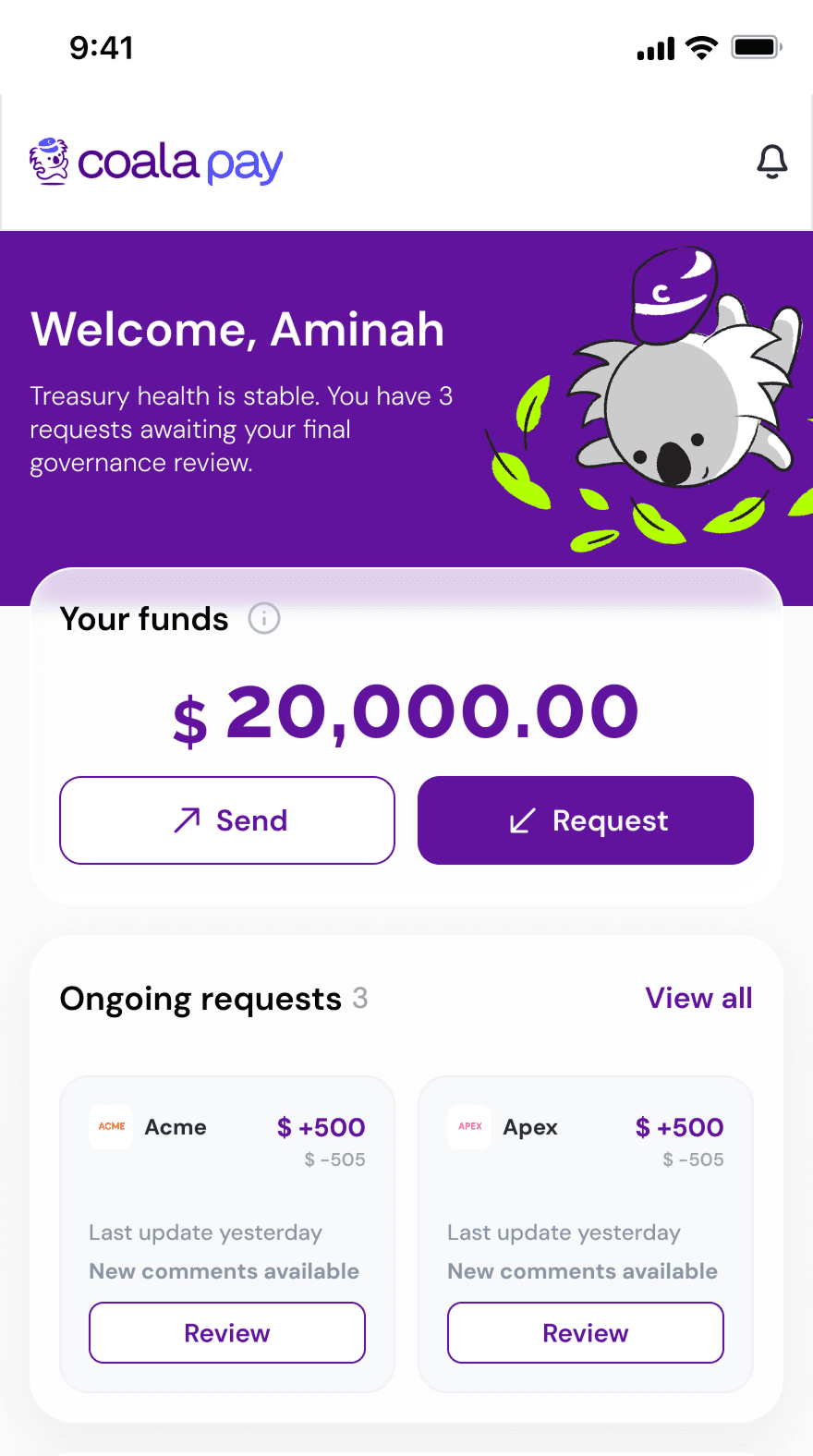
Solve access for your most difficult corridors today.
Every week spent waiting for a wire transfer is value lost to the frontlines. Switch on the only audit-ready rail built for unbankable zones.
Get started
Solve access for your most difficult corridors today.
Every week spent waiting for a wire transfer is value lost to the frontlines. Switch on the only audit-ready rail built for unbankable zones.
Get started
Solve access for your most difficult corridors today.
Every week spent waiting for a wire transfer is value lost to the frontlines. Switch on the only audit-ready rail built for unbankable zones.